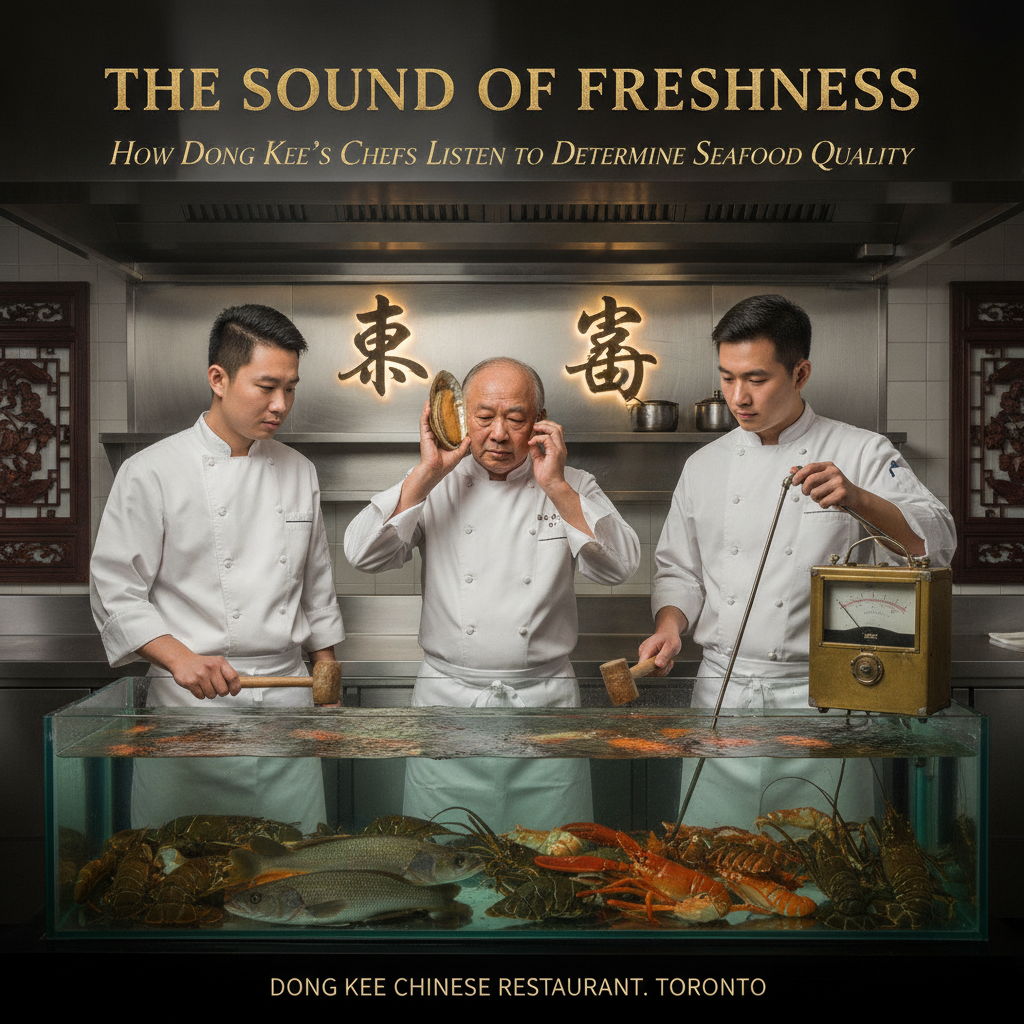
To the uninitiated, the live seafood tanks of a traditional Cantonese restaurant are a visual spectacle—a vibrant display of movement, color, and light. But to the seasoned culinary artisans at Dong Kee in Scarborough, the tanks are a complex acoustic environment. Long before a fish is scaled or a lobster is placed in the wok, its quality, vitality, and culinary destiny are determined by a sensory discipline rarely spoken of in modern culinary schools: the art of listening.
In the high-stakes world of Cantonese seafood cookery, the ultimate standard is *shengmeng* (生猛)—a term that translates literally to "raw and fierce," denoting an animal at the absolute peak of its life force. To assess this state, Dong Kee’s chefs rely on a lineage of sensory wisdom passed down through generations of coastal Guangdong masters. In the quiet hours before the dinner rush, when the dining room is still and the filtration systems hum their steady bassline, our chefs stand before the glass, listening to the subtle language of the water.
The Percussive Language of Crustaceans
When evaluating the Atlantic lobsters (*Homarus americanus*) and Dungeness crabs (*Metacarcinus magister*) that arrive daily at our Scarborough location, a chef’s hands and ears work in tandem.
For the lobster, the primary auditory cue is the tail slap. When lifted from the water, a healthy lobster will immediately flex its abdomen with powerful, rapid contractions. The sound of this movement is not a soft rustle, but a sharp, wet, percussive crack against the chef’s gloved hand or the sorting bin. A dull, sluggish thud indicates a lobster that has exhausted its energy reserves during transport.
Furthermore, our chefs listen to the shell itself. By gently pressing the carapace, they listen for the micro-friction of the joints. A high-quality, hard-shell lobster—one that is fully meat-yielding and rich in tomalley—will emit a tight, solid creak. A soft-shell lobster, which contains excess water and less meat, yields a muted, hollow click.
With Dungeness crabs, the auditory cue is the scrape. Healthy crabs are constantly active, their legs scratching against the glass and one another. A tank that produces a dry, metallic, and continuous scratching sound indicates a batch of crabs with high muscle density and active nervous systems. A quiet tank, conversely, warns the kitchen of lethargy.
The Resonant Slap of Finfish
For finfish, such as Green Bass, Tilapia, and Turbot, the acoustic indicators are found in the rhythm of the water’s surface.
A healthy fish does not merely swim; it commands its environment. When a chef approaches the tank, the sudden, explosive slap of a tail fin breaking the surface—a sound we call *paai-seoi* (排水, water-cleaving)—is the ultimate sign of vigor. This sound must be sharp and resonant, indicating strong lateral muscles.
When the fish is netted, the chef listens to the frequency of its gasping and the movement of its operculum (gill cover). A rapid, rhythmic clicking of the gill covers indicates a robust respiratory system, ensuring the blood is well-oxygenated. This physiological state is crucial; a fish harvested in a state of calm, high-energy vitality possesses lower lactic acid levels in its flesh, resulting in the clean, sweet, and firm texture that defines authentic Cantonese steamed fish.
The Hand as an Ear: Tactile Resonance
Ultimately, this auditory assessment is inseparable from tactile resonance. When our chefs hold a live fish, they are feeling the vibrations of its heartbeat and the tension of its spine. It is a form of listening through the skin. A fish that goes limp immediately is rejected; a fish that vibrates with a high-frequency tremor is destined for the steamer, where its flesh will bloom into delicate, snowy flakes under the influence of ginger, scallions, and hot oil.
At Dong Kee, we preserve these sensory traditions not out of mere nostalgia, but because they represent the highest level of culinary precision. In an era dominated by digital metrics and automated supply chains, the human ear remains the most sensitive instrument for measuring the true vitality of the sea. We invite you to join us in Scarborough, to sit near the hearth, and to appreciate the quiet, masterful discipline that goes into every dish we serve.